
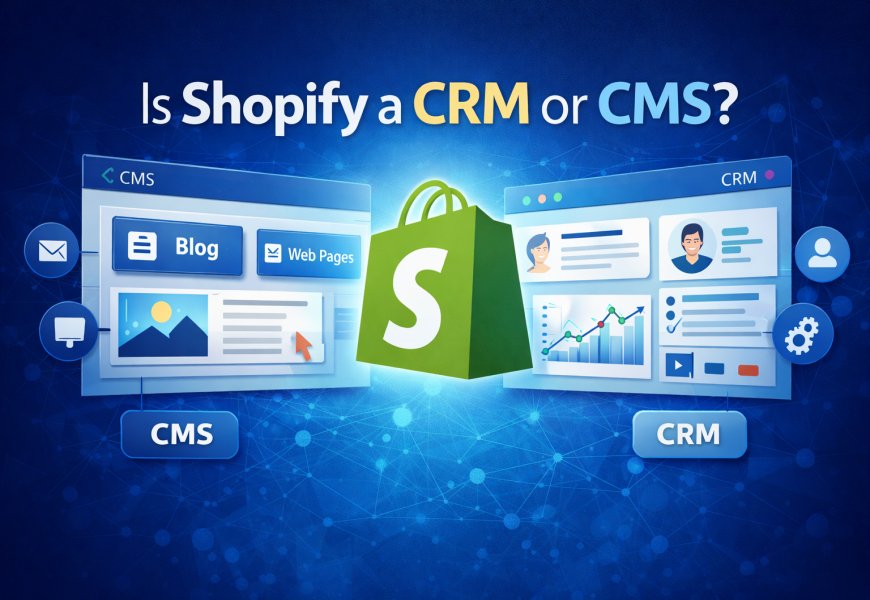
With the increasing number of digital companies that are developing new types of digital business software, many applications now integrate features from different types of applications into one piece of software. The result is often confusion about how to categorize certain types of software, such as Shopify. Oftentimes, questions about whether Shopify qualifies as either a CRM or CMS arise.
Understanding the distinction between these two types of software is key to ultimately picking the right types of tooling to leverage for managing both website and customer information as well as effectively managing your overall business operations. We’re going to explain what Shopify really does and where it properly fits in the spectrum.
What Is Shopify?
Primarily, Shopify is an e-commerce platform allowing business owners to build and manage their e-commerce shops. Everything you need to sell online — designing your e-Commerce site, processing payments from customers, tracking inventory, and managing your orders — is included in the platform.
Shopify is designed for e-commerce, unlike websites built on traditional web builders that are not specifically tailored for online sales. Therefore, your all-in-one solution is much more efficient and less complicated for people looking for a simple way to run an online business.
Understanding CMS (Content Management System)
A CMS (Content Management System) allows users to produce, manage, and post their digital content. It is important that users are aware that WordPress is one of the most popular content management systems (CMSs) because it is a flexible tool for creating blogs, landing pages, and media.
A CMS is a good choice for businesses that use a CMS for blogging, SEO purposes, or creating stories with their websites because it provides users with a high degree of control over how their content will be presented and optimized in the search engines.
Understanding CRM (Customer Relationship Management)
A CRM, or customer relationship management program, helps you manage your customer communications. Tools such as HubSpot provide ways for small business owners to record leads, automate messaging, and track customer relationships over a longer period of time.
CRM systems generally have a stronger emphasis on collecting data and building relationships than they do on creating beautiful websites. They help you to better comprehend your customer’s buying patterns, cultivate a productive sales pipeline, and develop personalized marketing plans for each of your customer’s buying patterns.
Is Shopify a CMS?
Although Shopify has some features similar to a CMS, it does not function as a traditional CMS. It allows the creation of product pages, blog publishing, and managing website content within its interface.
In spite of this limitation compared to a dedicated CMS, Shopify has features for content, just not as many features or depth as dedicated CMS platforms since Shopify is more geared towards eCommerce content than complex publishing. Therefore, while you can have a blog on Shopify, it does not provide the level of flexibility and sophistication that would be offered by other platforms like WordPress.
To summarize, Shopify is a CMS to the degree necessary to support the operations of an online store.
Is Shopify a CRM?
Shopify has basic customer management features but is not a full CRM. With Shopify, storeowners have access to customer information, can track order status, and see what customers purchased in the past.
While the features mentioned above are great, they don’t include advanced CRM-like capabilities. As a result, things such as automated messaging, sales funnel tracking, and tools for helping manage long-term customer relationships have been limited.
For any business where customer interaction and email marketing automation play a significant role, it becomes important to have a Shopify integration with a CRM.
What Is Shopify Best Described As?
Shopify is best defined as an e-commerce platform that includes elements of both CMS and CRM software. Shopify will fill the void between managing your website and managing your customer’s database. Shopify, however, does not replace either system but rather enhances and supplements them.
One of its key advantages is that it helps you simplify selling on the internet with enough features to manage your customers and content without needing supplementary applications to run your e-commerce business at the beginning stage.
When Should You Use Shopify?
When it comes to selling online, Shopify makes it easy. This is true especially if you are a new or small company looking for a quick and dependable way to get started selling products.
Over time, your business will likely develop needs that extend beyond what Shopify can offer by itself. At this point, adding on other tools to your store or integrating other platforms will be important for allowing you to grow your marketing efforts and build customer relationships.
Do You Need a CRM with Shopify?
When a store is small, the features built into Shopify are generally sufficient to help manage customers. As the number of customers you have grows, however, you will see a stronger need for a separate dedicated CRM.
A CRM (Customer Relationship Management system) will allow you to automate communication, segment your market, and build and maintain more intimate relationships with customers. Many companies choose to connect Shopify and systems like HubSpot in order to gain access to these types of functionality.
Advantages and Limitations of Shopify
Shopify’s greatest benefit is its simplicity and all-in-one design. There is no need to manage separate systems; businesses can simply focus on selling.
However, there are some limitations to using Shopify. The CMS function does not have the sophistication found in specialist platforms, and the CRM aspect is not highly developed. Therefore, it is best used as a basis for developing your digital business instead of providing a full-service answer to your digital business management needs.
Final Verdict
Shopify is not exclusively a CRM or a CMS but a comprehensive e-commerce platform, incorporating limited features from both types of systems.
This makes Shopify an ideal solution for companies looking to open and operate an online store with little to no technical difficulty. Further, those with more robust content initiatives or extensive customer relationship management needs may need to find additional support tools to complete their overall solution.
Conclusion
Whether to use a CRM, CMS, or an e-commerce platform is based on your objectives as an organization. Shopify distinguishes itself as it combines many of the essential features into one, complete package.
Shopify provides an excellent foundation for those that wish to develop their business online and a great opportunity for future growth through integrations.At Loyal Web Solutions, we help high-performing brands develop their successful, integrated, and innovative Shopify store. Developing the right strategy will lead to using Shopify as your long-term scalable and profitable online business.




Author Bio
By Hardip Koradia
Hardip Koradia, with over 15 years in the IT sector, masterfully blends Web Design, Development, SEO, and Digital Marketing, propelling Loyal Web Solutions since 2011 as its visionary CEO. Under his guidance, the firm has witnessed consistent growth and cultivated a team of mindful professionals. Off-duty, Hardip delves into internet research, sharing invaluable insights about the digital world, from web intricacies to mobile app trends.