
The search industry is evolving faster than ever.
Users no longer expect to click through several websites but instead want instant answers via Google AI Overviews (ChatGPT), Gemini, Perplexity and Microsoft Copilot.
This new shift in digital marketing has led to the introduction of AEO (Answer Engine Optimization).
AEO is a new approach to SEO that helps you make your content and-ready.
In this guide, you’ll learn:
- What AEO is
- How AEO works
- Why AEO matters
- AEO vs SEO
- The technologies behind answer engines
- Best AEO strategies
- Common mistakes
- Future trends
- Frequently asked questions
AEO (Answer Engine Optimization) refers to the creation, organization, and optimization of content in order for search engines, AI-powered answers engines, and other users’ devices, such as smartphones, tablets, or computers, to understand it, extract and display its direct response.
Rather than simply improving rankings, AEO focuses on increasing the chances that your content appears in:
- Google AI Overviews
- Featured Snippets
- People Also Ask
- Voice Search
- AI chatbots
- Knowledge Panels
Well-structured, authoritative, and question-focused content is more likely to be selected by answer engines.
What Is Answer Engine Optimization (AEO)?
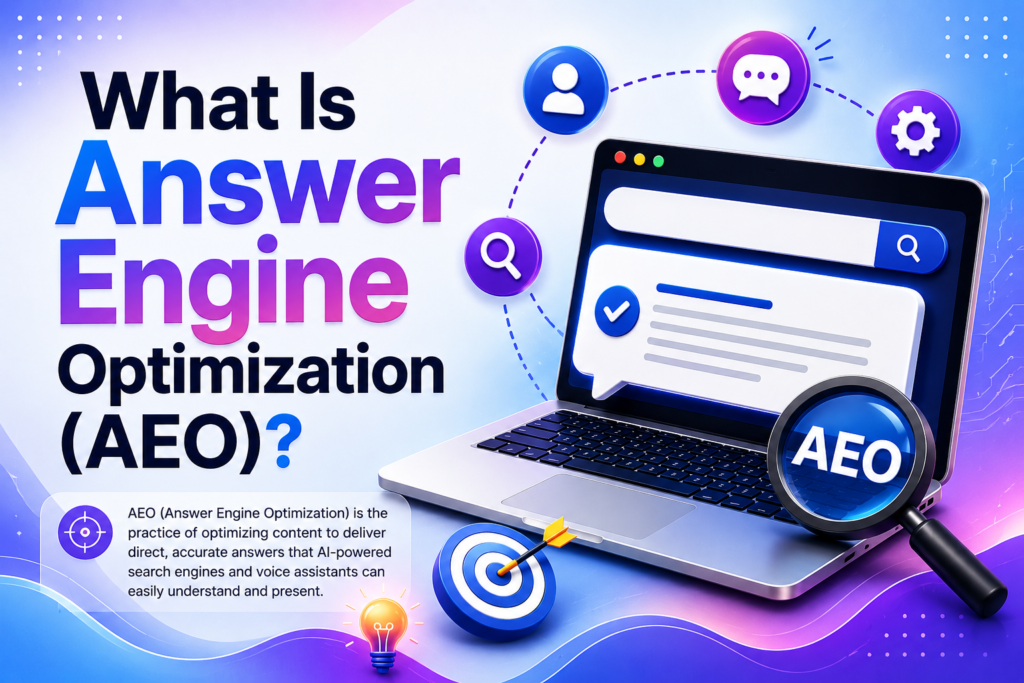
The evolution of SEO is Answer Engine Optimization.
AEO does not just optimize for SEO rankings but also for direct responses.
If someone asks you:
What is AEO?
Google, or an AI assistant, tries to give an answer immediately without the need for a user to go to multiple sites.
You want to be a trusted source.
Unlike old SEO strategies focused primarily on keywords, AEO emphasizes:
- User intent
- Clear answers
- Structured content
- Semantic relevance
- Topical authority
- Trustworthiness (E-E-A-T)
Why Is AEO Important?
Modern search behavior has changed dramatically.
Users now ask complete questions like:
- What is cloud computing?
- How does SEO work?
- Which CRM is best for startups?
- How much protein should I eat?
Instead of listing pages, answer engines use trusted sources to generate succinct responses. Optimizing direct responses has become important as AI-generated summaries, zero-click experiences and AI-generated summary become more prevalent.
Benefits include:
- Higher visibility
- More brand authority
- Increased trust
- Voice search optimization
- Better AI citations
- Qualified organic traffic
- Greater chances of appearing in Featured Snippets
How Does AEO Work?
Answer engines follow a multi-step process.
Step 1: User Asks a Question
Example:
“What is AEO and how does it work?”
The engine identifies:
- Intent
- Context
- Entities
- Search purpose
Step 2: Content Discovery
Search engines scan millions of pages looking for content that is:
- Relevant
- Accurate
- Current
- Authoritative
Step 3: AI Understands the Content
Modern AI doesn’t simply match keywords.
It analyzes:
- Context
- Semantic meaning
- Relationships
- Topic coverage
- User intent
Step 4: Answer Extraction
Instead of displaying an entire article, AI extracts:
- Definitions
- Bullet points
- Lists
- Tables
- Steps
- FAQs
This is why concise, well-structured answer blocks improve visibility.
Step 5: Response Generation
The AI combines information from reliable sources into a direct answer.
Your page may be:
- Quoted
- Summarized
- Cited
- Used as a primary source
The Technology Behind AEO
Several technologies power answer engines.
Natural Language Processing (NLP)
Helps machines understand human language.
Instead of matching words, NLP understands meaning.
Machine Learning
AI continuously learns which answers satisfy users.
Better answers become more visible over time.
Knowledge Graphs
Knowledge graphs connect entities like:
- People
- Companies
- Products
- Places
- Topics
Entity relationships improve answer quality.
Semantic Search
Semantic search understands:
- Intent
- Synonyms
- Context
- Related concepts
This reduces dependence on exact-match keywords.
Large Language Models (LLMs)
The LLMs, such as GPT Gemini Claude and other similar systems, synthesize data from different sources and generate responses in natural language. This makes clear, structured, and trustworthy content particularly valuable.
AEO vs Traditional SEO
| SEO | AEO |
| Focuses on rankings | Focuses on answers |
| Targets keywords | Targets questions |
| Measures traffic | Measures visibility and citations |
| Optimizes pages | Optimizes answer blocks |
| Blue links | AI responses |
| SERP rankings | AI Overviews, snippets, voice results |
The strongest digital strategies combine both SEO and AEO rather than treating them as competitors.
Where Does AEO Appear?
Your content can appear in:
Google AI Overviews
AI-generated summaries at the top of search results.
Featured Snippets
The answer box above traditional search listings.
People Also Ask
Expandable question-and-answer sections.
Voice Search
Responses delivered through:
- Google Assistant
- Siri
- Alexa
AI Chatbots
Including:
- ChatGPT
- Gemini
- Perplexity
- Claude
- Microsoft Copilot
Key Elements of AEO
1. Answer Questions Immediately
Start each section with a concise answer before adding detail.
2. Use Clear Heading Structure
Use descriptive headings such as:
- What is…
- How does…
- Why does…
- When should…
3. Write in Simple Language
Avoid unnecessary jargon.
Use short sentences.
4. Create FAQ Sections
FAQs naturally align with conversational search behavior.
5. Add Structured Data
Implement Schema.org markup where appropriate, including FAQ, HowTo, Organization, Product, Article, and Breadcrumb schema, to help search engines interpret your content.
6. Demonstrate E-E-A-T
Build:
- Experience
- Expertise
- Authoritativeness
- Trustworthiness
Include:
- Author information
- References
- Updated content
- Original insights
- Real examples
7. Build Topical Authority
Cover every aspect of a subject.
Instead of one article about AEO, create supporting content like:
- AEO vs SEO
- AEO Checklist
- AEO Tools
- AI Search Optimization
- Featured Snippets
- Voice Search SEO
Best Practices for AEO
- Understand search intent.
- Answer the main question within the first 50–100 words.
- Use descriptive H2 and H3 headings.
- Include numbered steps and bullet lists.
- Add comparison tables where helpful.
- Keep information accurate and current.
- Support claims with credible sources.
- Optimize for mobile performance and page speed.
- Strengthen internal linking.
- Refresh content regularly.
Common AEO Mistakes
Avoid:
- Keyword stuffing
- Long introductions before answering
- Weak page structure
- Duplicate content
- Thin articles
- Outdated information
- Missing schema markup
- Ignoring user intent
The Future of AEO
AI-powered search is becoming a core part of how people discover information.
As AI assistants become more capable, successful websites will increasingly focus on:
- Answer-first content
- Entity optimization
- Topic clusters
- Original research
- Expert insights
- Trust signals
- Conversational content
- Structured data
Brands that consistently publish accurate, helpful, and authoritative information are likely to have a stronger presence across both traditional search and AI-generated answers.
Final Thoughts
The answer engine optimization is not an extension of search engine optimization, but a response to the way people are searching today. Users expect AI systems to provide direct responses. Businesses that produce clear, structured, and trustworthy content will be better placed to gain visibility in Google AI Overviews.
Combining SEO and AEO is the most efficient strategy. SEO will help you build a strong foundation of content and technical knowledge. Then, add answer-focused SEO with structured data, topical authorities, concise answers, E-E.A.T signals, and structured responses. This approach integrates your content to give it the best chances of being found, trusted and surfaced anywhere users are looking for answers.
Frequently Asked Questions (FAQs)
AEO stands for Answer Engine Optimization.
SEO aims to improve rankings in search results, while AEO aims to make your content the direct answer shown by search engines and AI assistants.
No. AEO builds on SEO rather than replacing it. Strong SEO fundamentals remain essential for AI visibility.
Yes. Structured data helps search engines better understand your content, although it is only one of many factors influencing answer selection.



Author Bio
By Hardip Koradia
Hardip Koradia, with over 15 years in the IT sector, masterfully blends Web Design, Development, SEO, and Digital Marketing, propelling Loyal Web Solutions since 2011 as its visionary CEO. Under his guidance, the firm has witnessed consistent growth and cultivated a team of mindful professionals. Off-duty, Hardip delves into internet research, sharing invaluable insights about the digital world, from web intricacies to mobile app trends.