
Artificial Intelligence has been one of the most discussed technologies around the globe. AI has transformed the way we live and work. From ChatGPT to recommend movies and self-driving vehicles navigating streets, AI transforms how people do business and interact.
However, many people still use the terms AI and LLM (Large Language Model) interchangeably. While they are closely related, they are not the same thing.
An LLM is a kind of AI, but AI is more extensive than language models. Understanding this difference helps companies to select the appropriate technology, developers to create more effective tools, and typical users to become aware of the mechanisms they use.
In this guide, we’ll explain the difference between AI and LLM in simple language, explore how they work, compare their strengths and limitations, and discuss which technology is best for different use cases.
What Is Artificial Intelligence (AI)?
Artificial Intelligence is the term used to describe computer programs that are designed to do tasks normally performed by humans.
This includes learning, reasoning and problem solving, as well as recognizing pictures, understanding speech, taking decisions, translating language, etc.
AI is not a single technology, but a field of computer sciences with many branches and technologies.
Examples of AI include:
- Self-driving vehicles
- Facial recognition systems
- Fraud detection software
- Medical diagnosis tools
- Virtual assistants
- Recommendation engines
- Robotics
- Predictive analytics
Modern AI powers countless applications across healthcare, finance, education, manufacturing, retail, cybersecurity, and entertainment.
What Is an LLM?
LLM stands for Large Language Model.
It is a specialized type of AI trained on enormous amounts of text to understand and generate human language.
Instead of focusing on vision, robotics, or decision-making, LLMs specialize in language-related tasks such as:
- Answering questions
- Writing articles
- Summarizing documents
- Translating languages
- Generating code
- Creating emails
- Brainstorming ideas
- Explaining complex concepts
Popular examples include ChatGPT, Claude, Gemini, Llama, and Mistral.
An LLM predicts the next most likely word in a sequence, enabling it to generate fluent, natural-sounding responses.
The Simple Relationship Between AI and LLM
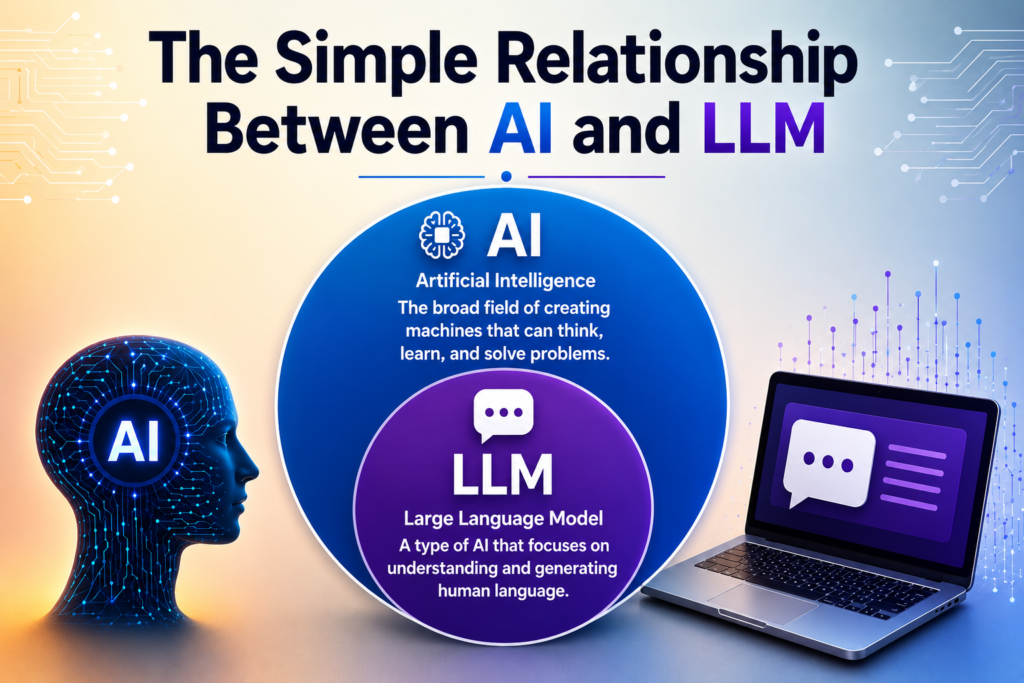
Think of AI as a large tree.
The trunk represents Artificial Intelligence.
One major branch is Machine Learning.
A branch of Machine Learning is Deep Learning.
One specialized branch of Deep Learning is Large Language Models.
So the relationship looks like this:
Artificial Intelligence → Machine Learning → Deep Learning → Large Language Models
This means:
- Every LLM is AI.
- Not every AI system is an LLM.
AI vs LLM: Key Differences
| Feature | Artificial Intelligence | Large Language Model |
| Definition | Broad field of intelligent systems | Specialized AI focused on language |
| Purpose | Solve many types of problems | Understand and generate text |
| Scope | Very broad | Narrower specialization |
| Input | Images, video, text, audio, sensor data | Primarily text |
| Output | Decisions, predictions, automation, recognition | Human-like language |
| Examples | Robots, recommendation systems, autonomous vehicles | ChatGPT, Claude, Gemini, Llama |
| Technologies | ML, Deep Learning, NLP, Computer Vision | Transformer neural networks |
How AI Works
Artificial Intelligence follows several steps:
1. Data Collection
AI systems gather information from different sources.
Examples include:
- Images
- Customer records
- Medical reports
- Financial transactions
- Videos
- Audio recordings
- Website activity
2. Training
Algorithms learn patterns from the collected data.
For example:
A fraud detection AI learns what fraudulent transactions look like.
3. Prediction
Once trained, AI predicts outcomes or makes decisions.
Examples include:
- Detecting spam
- Recommending products
- Identifying diseases
- Forecasting demand
4. Continuous Improvement
Many AI systems improve over time using new data and feedback.
How an LLM Works
LLMs are trained differently.
Instead of learning from images or sensor data, they consume massive amounts of text from books, websites, research papers, documentation, and public datasets.
Training involves:
- Learning grammar
- Understanding sentence structure
- Recognizing context
- Identifying relationships between words
- Predicting the next word
When you ask a question, the model predicts the most likely sequence of words to generate a useful response.
Where AI Is Used
AI powers countless industries.
Healthcare
AI assists doctors by analyzing medical scans, predicting diseases, and improving patient care.
Finance
Banks use AI for fraud detection, credit scoring, risk assessment, and algorithmic trading.
Retail
Retailers personalize shopping experiences, forecast inventory needs, and recommend products.
Manufacturing
Factories use AI for predictive maintenance, quality inspection, and automation.
Transportation
Self-driving vehicles rely on AI for navigation, obstacle detection, and route optimization.
Where LLMs Are Used
LLMs focus primarily on language tasks.
Popular applications include:
Content Writing
Generate blog posts, articles, product descriptions, and marketing copy.
Customer Support
Power AI chatbots capable of handling customer inquiries around the clock.
Programming
Generate code, explain programming concepts, and assist developers in debugging.
Education
Provide tutoring, summarize educational materials, and answer student questions.
Business
Draft emails, create reports, summarize meetings, and automate documentation.
Advantages of AI
Artificial Intelligence offers many benefits:
- Automates repetitive work
- Processes large datasets quickly
- Improves accuracy
- Reduces operational costs
- Supports better decision-making
- Works continuously without fatigue
- Enhances customer experiences
Advantages of LLMs
Large Language Models provide unique language capabilities.
They can:
- Write naturally
- Understand context
- Summarize lengthy documents
- Translate multiple languages
- Generate code
- Assist with research
- Answer questions conversationally
- Brainstorm creative ideas
Limitations of AI
Despite its strengths, AI has limitations.
Challenges include:
- Requires quality data
- Can inherit biases from training data
- May lack transparency in decision-making
- Can be expensive to develop
- Raises ethical and privacy concerns
Limitations of LLMs
LLMs also have important limitations.
They may:
- Produce incorrect information confidently
- Lack real-time knowledge unless connected to external data
- Struggle with complex reasoning in some scenarios
- Reflect biases present in training data
- Require significant computing resources for training and deployment
AI and LLM Work Best Together
Many modern applications combine traditional AI with LLMs.
For example, a customer support platform may use:
- AI to analyze customer behavior and detect sentiment.
- An LLM to generate natural, conversational responses.
Similarly, a healthcare solution might use:
- Computer vision AI to analyze medical images.
- An LLM to summarize findings into easy-to-read reports.
By combining different AI technologies, businesses can create more intelligent and user-friendly systems.
Which Should Businesses Choose?
The right choice depends on your goals.
Choose traditional AI if you need:
- Image recognition
- Fraud detection
- Predictive analytics
- Robotics
- Recommendation systems
- Process automation
Choose an LLM if you need:
- Content generation
- AI chatbots
- Document summarization
- Translation
- Coding assistance
- Knowledge-based question answering
Many organizations achieve the best results by integrating both approaches into a single solution.
The Future of AI and LLMs
AI is evolving rapidly. Systems are becoming better able to understand multiple data types, including text, images and audio. LLMs continue to improve in terms of reasoning, support for multilingualism, and expertise within specific domains.
In the future, AI systems will combine computer vision, speech and language recognition with decision making to create unified systems capable of assisting people in a variety of industries.
Businesses who adopt responsible technologies while considering privacy, security and ethical issues will improve their productivity, increase customer satisfaction, and accelerate innovation.
Which is better: AI or LLM?
Both are equally good. LLMs are best suited for language-based tasks. AI, on the other hand, is a broader term that covers a wide range of intelligence technologies. Your use case will determine the best option.
Final Thoughts
Artificial Intelligence (AI) and Large Language Models have a close relationship, but serve separate purposes. AI is a broad range of technologies which enable machines to learn, perceive, act, and reason. LLMs is a branch of AI that focuses on understanding and producing human language.
Knowing the differences between AI and LLM is important as organizations adopt more intelligent technologies. It helps them select the best solution to solve the problem. Understanding where each technology belongs is key to making the right decisions.
SEO Services are tailored to meet your specific business needs. Our expert team works on everything from technical optimization, keyword strategy, to creating high-quality, relevant content. We also focus on delivering sustainable growth for your business.
Frequently Asked Questions
No. AI is the broader field of creating intelligent systems, while an LLM is a specific type of AI designed for understanding and generating human language.
ChatGPT is an AI application powered by a Large Language Model. It combines an LLM with additional systems for conversation, safety, and tool use.
Yes. Many AI systems, such as recommendation engines, autonomous vehicles, and image recognition software, do not use LLMs.
No. Traditional chatbots often rely on predefined rules or decision trees. Modern conversational chatbots increasingly use LLMs to provide more natural and flexible interactions.




Author Bio
By Hardip Koradia
Hardip Koradia, with over 15 years in the IT sector, masterfully blends Web Design, Development, SEO, and Digital Marketing, propelling Loyal Web Solutions since 2011 as its visionary CEO. Under his guidance, the firm has witnessed consistent growth and cultivated a team of mindful professionals. Off-duty, Hardip delves into internet research, sharing invaluable insights about the digital world, from web intricacies to mobile app trends.