
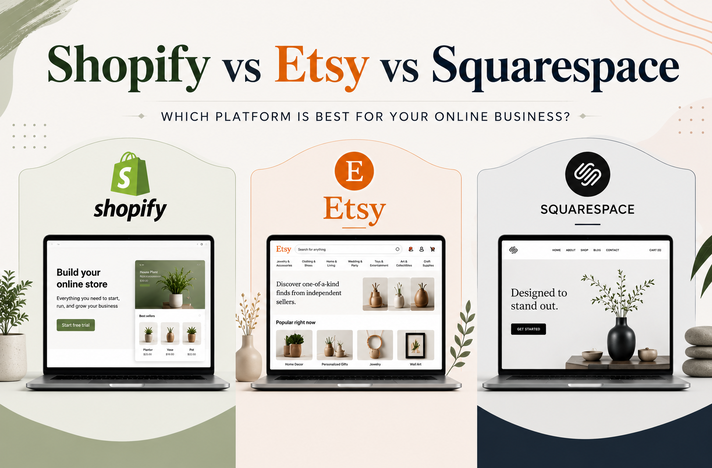
Choosing the best eCommerce platform will have a significant impact on your ability to launch your shop, gain customers, process orders and grow your company. Shopify, Etsy and Squarespace, three of the most popular platforms, are all designed to cater for different sellers.
Etsy’s primary purpose is to connect sellers with shoppers who are already looking for specific products. Shopify was designed for companies that require greater control, scalability and flexibility. Squarespace is a professional website builder with eCommerce features. This makes it attractive for creators, brands, and service companies that are looking to create a polished visual website.
Which platform would you recommend?
Answers will vary depending on your product, the way you intend to reach customers, what level of control you require, and how far you wish to take your business in the future.
Shopify vs Etsy vs Squarespace at a Glance
| Feature | Shopify | Etsy | Squarespace |
| Best for | Growing online stores | Handmade, creative & unique products | Design-focused brands & small businesses |
| Platform type | Dedicated eCommerce platform | Online marketplace | Website builder with eCommerce |
| Own website | Yes | Limited marketplace presence | Yes |
| Built-in marketplace audience | No | Yes | No |
| Design flexibility | High | Low | Very high |
| Product management | Excellent | Good | Good |
| Scalability | Excellent | Moderate | Good |
| Branding control | Excellent | Limited | Excellent |
| SEO control | Strong | Marketplace SEO | Strong |
| Ease of use | Easy to moderate | Very easy | Very easy |
| Best long-term choice | Shopify | Etsy + own store | Squarespace |
What Is Shopify?
Shopify, a platform for eCommerce designed specifically to assist businesses in creating and managing their online shops.
Shopify is not Etsy. Customers do not browse other sellers on Shopify. You build your storefront, but you are also responsible for marketing it through other methods, such as SEO, social networking, advertising, email, content, etc.
Shopify offers features such as product management, payment, shipping, analytics and marketing. Shopify’s plans include AI-assisted commerce tools and the ability to sell through marketplaces, social media, and AI channels.
Shopify is ideal for:
- Growing eCommerce businesses
- Fashion and clothing brands
- Electronics stores
- D2C brands
- Businesses with large product catalogues
- Businesses planning international expansion
- Sellers who want extensive integrations and customization
Shopify’s biggest advantage
Scalability.
Start with a small catalog and grow into a larger operation, without having to switch platforms.
Shopify is a subscription-based service, so adding apps and third-party services will increase the total cost of your operation.
What Is Etsy?
Etsy differs from Shopify in that it’s primarily a market.
You can create an Etsy store and then list your products on Etsy. It allows potential clients to find your product while browsing Etsy.
Etsy offers a built-in exposure to the marketplace, which is one of its biggest benefits for new sellers.
Etsy focuses on products which are hand-picked or designed by its sellers, as well as those that have been made according to their policies.
Etsy is ideal for:
- Handmade products
- Jewellery
- Artwork
- Craft products
- Personalised gifts
- Printables and certain digital products
- Creative products
- Small businesses testing product demand
Etsy’s biggest advantage
Access to an established marketplace audience.
It is not necessary to start from scratch with an independent Shopify website or Squarespace site.
You are competing with Etsy’s other sellers directly, which means that product quality, price, customer reviews, photos, optimization of listings, and service to customers can all make a difference.
Etsy fees to consider
Etsy charges $0.20 per listing and 6.5% for each transaction. Payment processing fees can vary depending on the seller’s location. Offsite Ads may also charge additional fees if an attributed transaction occurs. Etsy charges a payment processing fee of 3-5% plus Rs25 for sellers in India.
Sellers should therefore calculate the total cost of a sale, rather than just looking at listing fees.
What Is Squarespace?
Squarespace allows you to build a site using professionally-designed templates. It also offers branding tools, integrated commerce, content management and content management.
Squarespace can be a great option for websites that need to perform more than just sell products. A photographer, designer or consultant may need a site that includes services, blogs, contact details, and a shop.
Squarespace’s website plans and digital products have changed as a result of recent updates. Sellers should review the details and fees before buying.
Squarespace is ideal for:
- Creatives and designers
- Personal brands
- Portfolio-based businesses
- Small product catalogues
- Service businesses selling products alongside services
- Businesses prioritising visual branding
- Businesses that want website + content + eCommerce together
Squarespace’s biggest advantage
Design and brand presentation.
If your business depends heavily on visual storytelling, Squarespace can provide a strong balance between website design and online selling.
Shopify vs Etsy vs Squarespace: Detailed Comparison
1. Ease of Use
The three platforms reduce the amount of technical expertise required for online sales.
The Etsy platform is the easiest place to start, as you don’t need to create a website. Create your store, upload product listings and add information about the products. Then, you can start selling in the market.
Shopify is more complicated to set up because it requires you to build your own storefront. Its interface, however, is specifically designed for eCommerce, with extensive tools to manage products, orders and payments.
Squarespace also makes it easy for beginners to start a site and an online store.
Shopify wins for eCommerce management and simplicity.
2. Branding and Design
As your business grows, it becomes more important to control your brand.
Shopify allows you to create a dedicated storefront for your brand, customize themes, add apps, link your domain and build an experience around it.
Squarespace excels at visual presentation with its professionally designed layouts, and website-first strategy.
Etsy offers much less control, because your shop is located within Etsy’s marketplace. Your listings must work with Etsy’s overall buying experience.
Shopify and Squarespace are the winners.
3. Customer Acquisition
The biggest difference between these two platforms is the platform.
Customers are already searching for products on Etsy. Etsy can be attractive to new sellers who do not have a large audience.
Shopify and Squarespace require you to drive more traffic yourself.
- You can also find out more about SEO by clicking here.
- Google Search
- Social media
- Advertising that is paid
- Email marketing
- Influencer marketing
- Content marketing
- Direct traffic
Shopify and Squarespace require more initial marketing efforts, but they give you greater control of your brand and customer acquisition strategy.
Winner: Shopify for brand building and long-term marketplace discovery, but Etsy as a marketplace for discovering new products.
4. SEO
Search engine optimization is essential if you want your customers to find your products via search engines.
Shopify offers a strong foundation for eCommerce SEO. This includes control over key store elements, as well as the ability to extend functionality via apps and integrations.
Squarespace is a website builder and content manager that combines product pages with landing pages, blogs and brand content.
Etsy’s marketplace search is its own system. However, your shop will operate within Etsy and not as an independent website.
Owning an independent site is a good option for businesses that are serious about organic search visibility. It gives them more control over their SEO strategy.
Shopify wins for eCommerce SEO, Squarespace wins for content-led brands
5. Scalability
Scalability is important to consider before selecting a platform if you anticipate your business will grow.
Shopify, a platform built for eCommerce, offers multiple plans and features such as inventory management, analytics and multichannel sales.
Etsy is a great place to start for small businesses and creative individuals, but there are limitations in terms of the customer experience.
Shopify, a specialised eCommerce ecosystem that is more suited to businesses with complicated requirements for online commerce, may be able to support businesses in the future.
Winner: Shopify.
Shopify vs Etsy vs Squarespace: Which Is Cheaper?
There is no universal winner because the cost structure is different.
Shopify
Shopify operates on a subscription-based model. The current US Pricing page shows the Basic Plan at $29/month if billed annually or $39/month if billed monthly. Higher tiers are available for businesses that grow. You should also consider the costs of payment processing, as well as any third-party fees.
Etsy
Etsy has lower upfront barriers, but sellers pay listing, transaction, payment processing, and potentially advertising-related fees.
Squarespace
Squarespace offers subscription plans with varying fees for digital products and commerce transactions. These vary depending on the product and plan. Squarespace’s documentation indicates that digital product transaction fees range from 7% for Basic up to 0% for Advanced.
Your sales volume, average purchase value, number of products, marketing needs, and product counts will determine the cheapest platform, not just your monthly subscription fee.
Shopify vs Etsy vs Squarespace: Pros and Cons
Shopify Pros
- Built specifically for eCommerce
- Strong scalability
- Excellent product and inventory management
- Extensive app ecosystem
- Strong branding control
- Supports multiple sales channels
- Suitable for international growth
- Strong analytics and marketing capabilities
Shopify Cons
- Monthly subscription cost
- Additional apps can increase expenses
- You generally need to generate your own traffic
- Some advanced features may require additional tools or higher plans
Etsy Pros
- Easy to get started
- Established marketplace
- Good fit for handmade and creative products
- Lower initial commitment
- Useful for testing product demand
- Customers can discover products through Etsy search
Etsy Cons
- Strong competition
- Less branding control
- Multiple seller fees
- Customer experience is tied to the marketplace
- Less suitable for businesses wanting a highly customised independent store
Squarespace Pros
- Excellent visual design
- Professional templates
- Easy website management
- Combines content and eCommerce
- Good option for creatives and personal brands
- Strong for websites that sell products and services together
Squarespace Cons
- Not as eCommerce-focused as Shopify
- Less suitable for highly complex stores
- Plan and transaction fees need careful evaluation
- Marketplace traffic is not built in like Etsy
Which Platform Should You Choose?
Choose Shopify if:
You want to build a serious eCommerce brand, expect your product range to grow, need advanced store functionality, or want maximum control over your online shopping experience.
Best overall choice for most growth-focused eCommerce businesses: Shopify.
Choose Etsy if:
You sell handmade, personalised, artistic, craft, or other creative products and want to test demand using an established marketplace.
Best for marketplace-based selling: Etsy.
Choose Squarespace if:
Your priority is a beautiful website that combines eCommerce with content, services, portfolio pages, blogging, or personal branding.
Best for design-focused businesses: Squarespace.
Can You Use Shopify and Etsy Together?
Yes. In fact, using both can be a practical strategy.
You could use Etsy to reach marketplace shoppers while building Shopify as your primary branded website.
For example:
Etsy → Product discovery and marketplace sales
Shopify → Brand website, customer experience and long-term growth
This approach allows a business to benefit from Etsy’s marketplace while gradually building an independent eCommerce presence.
What About Squarespace and Etsy Together?
This can also make sense.
A creative business could use Etsy for marketplace exposure while using Squarespace as its professional website.
For example, a photographer could have:
- Squarespace website
- Portfolio
- About page
- Blog
- Services
- Contact page
- Etsy shop for selected products
This gives the business a stronger branded web presence without completely abandoning marketplace selling.
Conclusion
The right platform will determine your store’s flexibility and growth. It can also influence the customer experience. This comparison of Shopify, Etsy, and Squarespace looks at their main features, cost, ease-of-use, and best use cases. It helps entrepreneurs to make an informed decision, based on the products they sell, their budgets, their branding goals, as well as their long term eCommerce strategy.





Author Bio
By Vishal Patel
Vishal Patel is the Chief Technology Officer at Loyal Web Solutions, where he has been a key leader since 2011. With a deep understanding of web technologies and a passion for innovation, Vishal has guided the company to consistently deliver top-tier digital solutions. His expertise in the industry ensures that every project is executed with precision and excellence.