
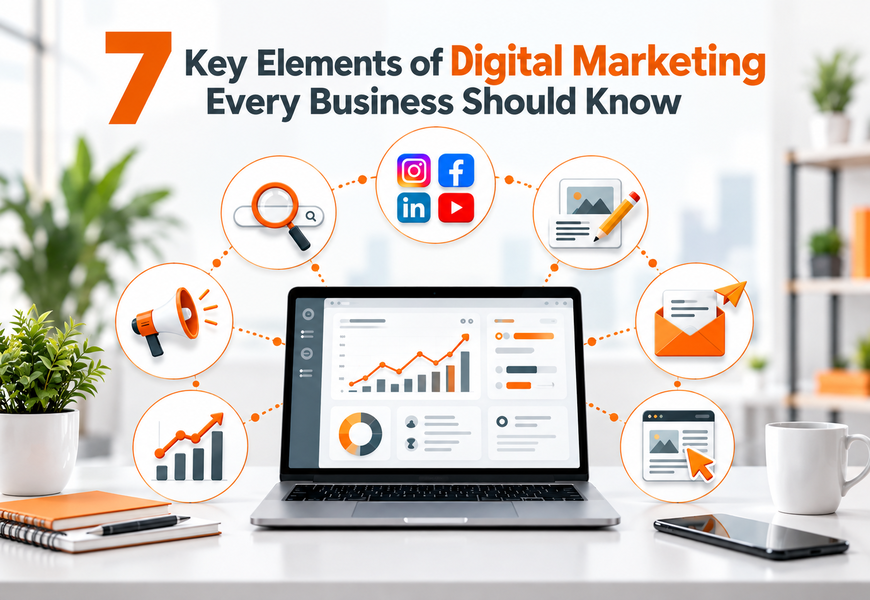
Digital marketing is now an integral part of the modern growth strategy for businesses. A strong online presence is important for any business, whether it’s a local small company, a big organisation or an eCommerce site. It can connect you with customers, increase brand awareness and help generate leads.
Digital marketing does not only mean posting to social media and running ads online. Successful strategies combine several channels to engage and convert audiences.
What are the seven key elements to digital marketing? Here are some of the key elements that businesses need to understand in order to develop an online marketing strategy.
1. Search Engine Optimization
Search Engine Optimisation (also known as SEO) is a process that improves a site’s visibility on search engines.
SEO allows your site to appear when people are searching for information, products or services related to your company.
Keyword research and quality content creation are essential to effective SEO. Other factors include internal linking, mobile optimization, technical improvements of the website, and backlink building.
SEO strategies that are well planned can help increase website traffic organically and reach customers who already search for solutions.
2. Content marketing
The content marketing strategy focuses on providing useful, relevant and interesting information to your audience.
You can use blog posts, guides videos, infographics case studies FAQs and other educational materials.
Content marketing is a way to provide real value and answer questions from customers instead of constantly promoting your products.
Content of high quality can support SEO, allowing companies to naturally target key search terms. Content that is informative can build trust over time and establish authority. It will also encourage customers to find out more about you.
3. Social Media Marketing
Businesses can communicate with their customers directly using social media.
Facebook, Instagram and LinkedIn are all platforms that can be utilized to promote business, share educational material, video content and product information.
Your target audience, business objectives and your chosen platform will determine the best platforms for you.
Social media can help improve your brand’s visibility and engagement. It will also drive traffic to your site and build relationships between you and potential customers.
4. Paid Advertising
Digital advertising paid allows companies to target specific customers more efficiently.
Examples of advertising campaigns include Google Ads and social media ads, as well as display campaigns, online shopping campaigns, remarketing campaigns, and Google Ads.
The ability to target users is a major benefit of paid advertisements. Businesses are able to reach customers based on their location, preferences, previous interactions with websites, demographics and search behavior.
Effective advertising relies on a careful selection of keywords, creative and effective content, landing pages that work, as well as regular performance monitoring.
Paid campaigns, when managed correctly, can help generate leads, drive website traffic and boost online sales.
5. Email Marketing
Email marketing is a powerful digital marketing tool for keeping in touch with clients and prospects.
Email campaigns can be used by businesses to communicate useful information such as company updates, new product releases, announcements of special events, educational material, and personalized recommendations.
By keeping in touch with those who are already interested in your company, email marketing helps to retain customers.
It is important to segment and personalise. It is usually better to send relevant messages to certain groups than to all.
6. Website and User Experience
Digital marketing strategies often revolve around your website.
Poor website performance may discourage users from taking further action, even if paid advertisements, SEO and social media are successful in generating traffic.
Websites should be easy to use, fast and mobile friendly, with a professional look, as well as clear on the services or products being offered.
It should be easy to perform important actions, such as asking for a quotation, purchasing, filling out a form or calling the company.
A smooth experience for users can convert website visitors to enquiries and clients.
7. Data analytics and performance Tracking
When decisions are backed by data, digital marketing is more effective.
Analytical tools help businesses understand the interaction of visitors with digital content, such as websites, email, ads, and emails.
The metrics that are important include traffic to the website, conversions and cost per lead.
Reviewing these results regularly helps business understand what works and where improvement is needed.
Businesses can use data on performance to improve their marketing efforts and adjust their campaigns.
Conclusion
The key components of digital marketing include paid marketing, social media, content marketing and email marketing.
The digital marketing strategy that is most effective usually combines several elements rather than depending on just one.
Email can improve customer relations, SEO can help attract organic traffic, paid advertisements can reach a wider audience, a well designed website can encourage conversions, and social media and content marketing can boost engagement. The analytics helps measure business performance, and then make informed improvements.
Businesses can increase their visibility online, connect with relevant audiences and create a solid foundation for digital growth by creating a digital strategy based on these seven components.




Author Bio
By Hardip Koradia
Hardip Koradia, with over 15 years in the IT sector, masterfully blends Web Design, Development, SEO, and Digital Marketing, propelling Loyal Web Solutions since 2011 as its visionary CEO. Under his guidance, the firm has witnessed consistent growth and cultivated a team of mindful professionals. Off-duty, Hardip delves into internet research, sharing invaluable insights about the digital world, from web intricacies to mobile app trends.